Summoners War
- 3.9
- Rating
- 50.00M
- Installs
- Free
- Price

 Analysis by App-foxy
I approached Summoners War X The LOTR expecting a familiar mobile role-playing game, but its appeal became clearer after several short sessions. The important question is not whether it offers a huge amount of content; it does. The better question is what makes me return after finishing one battle. In my experience, the answer is a compact loop: choose a team, make a few meaningful decisions, watch the result, collect something useful, and then find a reason to improve the next attempt.
That loop sits inside Summoners War, a free game from Com2uS with a Lord of the Rings collaboration at its center. It is aimed at Teen players and has been available since June 2, 2014, so this is not a new experiment trying to find its identity. It is an established mobile RPG with a large audience, a mature progression structure, and enough systems to reward players who enjoy learning how their collection works.
I would recommend it to someone who likes building teams over time rather than rushing through a single story. I would be more cautious with anyone who wants a completely relaxed game that never asks them to manage resources, compare abilities, or think about repeated battles. The first few minutes are welcoming, but the long-term experience is about planning.
You May Also Like

 Pandora - Music & Podcasts
Pandora’s Music Is Easy to Start, but Harder to Recover
Pandora’s strength is its low-effort path from a seed to a station. Its weak spot is how much confidence it asks you to place in connection, setup, and quiet recovery.

 8 Ball Pool
 Is Built on Rivalries, Rematches, and Routine
A close look at the rivalries, rematches, shared routines, and unanswered safety questions that turn a quick pool match into a persistent mobile community.

 Samsung Music
’s Quiet Strength Is Playing What You Already Own
Its reach comes less from spectacle than from dependable access to a personal library. That simplicity is both the app’s strongest retention engine and its ceiling.

 AccuWeather: Weather Radar
AccuWeather Review: A Quick, Clear Forecast for Everyday Decisions
For everyday plans, the best forecast is the one you can understand quickly. AccuWeather makes rain timing, radar, and local conditions easy to act on, with a few trade-offs.

 Hill Climb Racing
Why Hill Climb Racing Still Turns Crashes Into One More Run
A tiny car, a bumpy hill and one more upgrade: Hill Climb Racing keeps resurfacing because its simple chaos makes every near-miss feel personal.

 AliExpress - Shopping App
AliExpress Makes Global Shopping Feel Personal, but Shoppers Bear the Risk
AliExpress turns a global marketplace into a pocket-sized discovery engine. Its reach is useful, its shopping loop compelling, and its trade-offs easy to miss.
More From Our News Desk
View All News


From the first action to the reason another session begins
I frame this section around the small decision that starts each fight: what problem does my team need to solve, and which lineup gives me the best chance? That keeps the combat choices grounded in preparation rather than reflexes. From there, I look at why the result sends me back to the roster with a new idea for the next session.
The first action is choosing what kind of problem to solve
The first satisfying decision is not simply tapping an attack button. It is deciding which characters belong together and what you want the team to accomplish. A group that survives comfortably may still be too slow, while a powerful damage-focused setup can struggle when an opponent exposes its weaknesses. That makes each battle feel less like a one-off animation and more like a small test of preparation.
The turn-based structure gives me enough time to read the situation. I can consider whether to remove a threat immediately, protect a vulnerable ally, or use a skill now and accept a longer wait before it is available again. The choices are easy to understand at first, but their consequences become more noticeable as enemies demand different responses.
This is where the game separates itself from simpler action RPGs. In a real-time alternative, I might rely on reflexes and constant movement. Here, the important skill is recognizing patterns and assembling a group that covers its own weaknesses. That is a better fit for short commutes, waiting rooms, or evenings when I want interaction without needing to keep both hands busy every second.
The Lord of the Rings collaboration gives the opening experience extra familiarity, especially for players who already enjoy that world. Still, the game does not depend only on recognition. The practical appeal comes from seeing how familiar collaboration elements fit into a collection-based RPG, then deciding whether they genuinely improve a team or simply look attractive in the roster.
Feedback arrives through every battle decision
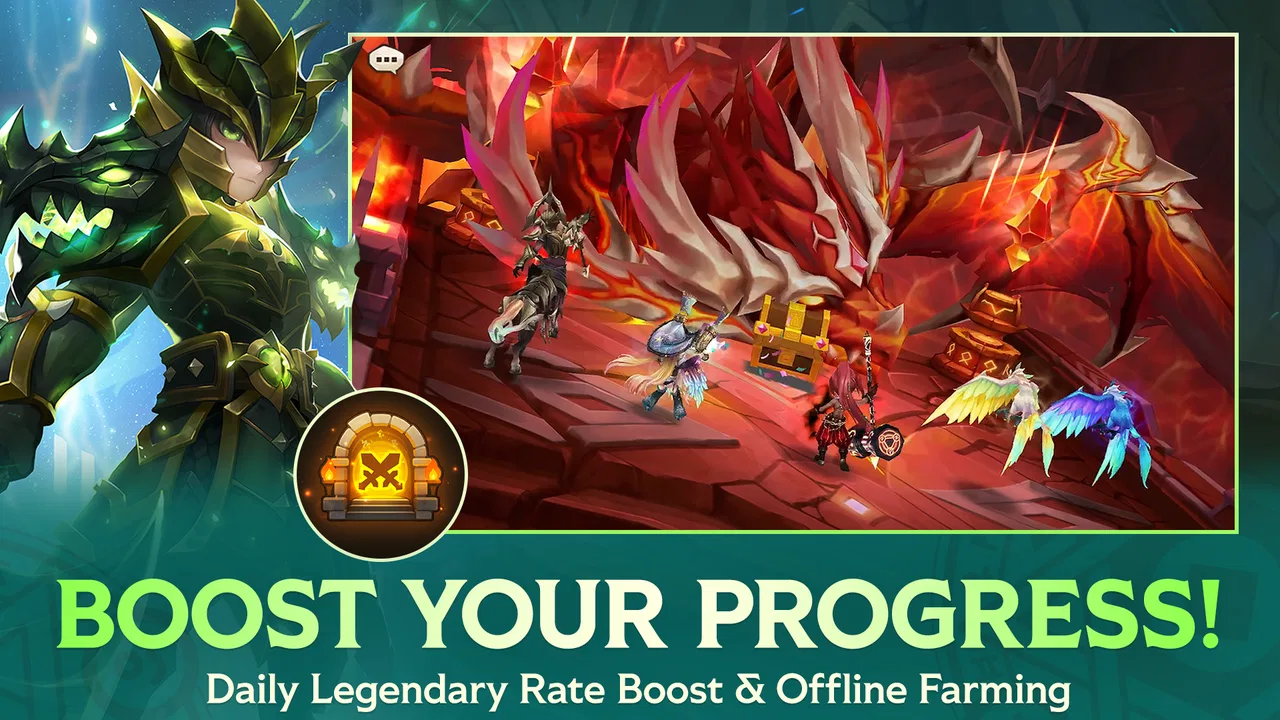
The feedback rhythm is one of the strongest parts of the experience. I make a choice, see the skill resolve, watch the team’s health and status change, and immediately understand whether the decision helped. A successful turn can stabilize a difficult fight; a careless one can leave the whole group exposed. That clear connection between action and result keeps routine battles from feeling completely empty.
Even when I use automated combat for easier encounters, I still have a reason to check the result. Automation is useful for repeating content, but it does not remove the need to understand why a team succeeds or fails. When a run goes badly, the answer is often not “tap faster.” It may be that the lineup lacks protection, the damage is arriving too slowly, or the chosen skills are poorly suited to the encounter.
That distinction matters for new players. Auto-play can make progress comfortable, but it can also hide the lesson behind a defeat. I found it more useful to watch difficult stages manually first, identify the dangerous moment, and only then let the game handle easier repetitions. This turns automation into a time-saving tool instead of a substitute for learning.
The game also creates a useful tension between immediate power and long-term value. Improving one favorite character can make the next battle easier, but spreading resources across a balanced group may open more options later. I recommend resisting the urge to upgrade every new addition immediately. A focused team usually teaches more than a wide collection of half-developed units.
Rewards make the next attempt feel practical
Winning is satisfying because the reward is not merely a screen of celebration. The result feeds back into the collection and gives me something to evaluate. A new character, an upgrade opportunity, or another useful resource can change how I view the next stage. The best rewards are the ones that create a decision rather than simply increasing a number.
This is also where the free-to-play structure deserves an honest look. The game costs nothing to start, but in-app purchases range from $0.99 to $99.99 per item. That wide range means the store can become part of the experience, especially for players who want faster progress or more chances to expand their collection. I did not find spending necessary to understand the core loop, but I did feel the pressure more clearly once progression became slower and the roster demanded more attention.
My advice is to decide your spending boundary before the game gives you a tempting shortcut. If you treat purchases as optional convenience rather than a solution to every difficult stage, the experience is easier to control. If you dislike collectible progression with optional spending, this is a warning sign rather than a minor detail. A traditional single-purchase RPG may suit you better.
Rewards also have a psychological trap: a new addition can feel exciting even when it does not fit the team I am currently building. I learned to ask three questions before investing: does this character solve a problem I actually have, does it complement my existing skills, and will developing it delay a more useful upgrade? Those questions prevent the roster from becoming a crowded storage room full of possibilities I never use.
The session resets because improvement is unfinished
A typical session can end after a successful battle, but the game rarely makes that feel final. I may have earned enough to strengthen a unit, discovered a weakness in the current lineup, or reached a stage where a different approach could work. The reset is not a hard restart; it is a return to preparation with slightly better information and, ideally, slightly better tools.
This is why the game works well in short bursts. I can complete a few tasks, improve one part of a team, and stop without needing to finish a long uninterrupted chapter. At the same time, the same structure can become repetitive. Repeating a stage for materials is useful when I have a clear target, but dull when I am doing it only because the next upgrade feels distant.
I suggest entering each session with a small purpose. For example, I might focus on testing a defensive change, preparing one character for a harder encounter, or collecting what is needed for a specific improvement. That approach makes the reset feel like a plan for the next attempt rather than an endless cycle of tapping through familiar screens.
Players who enjoy routine optimization will probably appreciate this. Players who need constant novelty may feel the repetition sooner. The game’s long-term appeal depends heavily on whether improving a team is itself enjoyable to you. If it is, the reset is motivating. If it is not, the amount of content can feel more like a workload than an adventure.
What makes the progression deeper than it first appears
The most useful advanced habit is to build teams around jobs, not just rarity or visual appeal. A character that looks powerful may not help if the rest of the group cannot keep it alive or support its timing. I had better results when I considered the whole sequence of a fight: who starts the pressure, who keeps the team stable, who removes a dangerous effect, and who finishes the encounter.
Another practical insight is to separate testing from farming. Difficult content is where I want to make decisions and observe results. Repeated farming is where I want consistency and speed. Using the same team for both purposes can waste time: a safe team may be too slow for repetition, while an experimental team may fail too often to be efficient.
A third trade-off concerns attention. Manual play gives me more control and helps reveal why a battle is going wrong, while automation reduces effort during predictable stages. I would not use auto-play as my first response to a defeat. I would use it after I understand the stage and know that the team can handle it reliably. That small change makes the game feel much less random.
Finally, I found that saving resources for a clear objective is more rewarding than upgrading whenever the game presents the option. Progress feels faster when every improvement supports a plan. This is particularly important for free players, because inefficient upgrades can make the wait for the next meaningful breakthrough feel longer than it needs to be.
Who will enjoy it, and who should choose something else
This is a strong choice for players who enjoy collection-based role-playing games, turn-based decisions, and gradual team refinement. It suits people who like checking a roster, experimenting with combinations, and returning to a stage after learning from a failed attempt. The Lord of the Rings collaboration may also make the starting point more inviting for fans who want recognizable flavor inside a mobile RPG.
It is less suitable for someone looking for a compact premium adventure with a definite ending. It is also not my first recommendation for players who dislike repeated battles, optional purchases, or progression that asks them to think about where resources go. A fast action game will provide more immediate physical excitement, while a story-first RPG will usually offer a clearer narrative destination.
The Teen content rating is another reason I would consider the intended audience before recommending it to a younger player. Parents should look at the game as a collection-focused RPG rather than assuming that a familiar fantasy collaboration automatically makes it suitable for every age.
On supported devices, the current version is 9.1.3 and the minimum operating system is Android 5.0. That makes the technical entry point relatively broad for an established mobile game, although actual comfort can still depend on the device and how much content is being loaded. I would keep enough storage available and use a stable connection when updating or moving through online features, rather than treating it like a fully offline game.
The loop verdict: rewarding when the plan matters
My overall impression is that Summoners War works because its loop has a clear shape. I take action by selecting a team and making combat decisions. I receive feedback through the outcome of each turn. I earn a reward that can change my options. I reset by returning to preparation, then begin again because the next attempt may succeed with a better plan.
That structure sounds simple, but the balance between control and repetition is what determines whether it lasts. I enjoyed the game most when I had a concrete problem to solve. I enjoyed it least when I repeated content without knowing what improvement I was working toward. The difference is not a hidden button or a special trick; it is how deliberately I approached the progression.
With an average rating of 4.0 from around 2.3 million ratings and over 50 million installs, it is clear that the format has reached a very large mobile audience. Those figures do not guarantee that it will match every player’s taste, but they fit my experience of a polished, long-running RPG built around collection and optimization rather than a short campaign.
Com2uS has made something that is easy to start and increasingly demanding to master. I would recommend trying it if you like the idea of turning each battle into a small experiment and each reward into a planning decision. I would skip it if you want a game that stays fresh without repetition or never brings spending into the conversation. For the right player, the best reason to begin another session is not simply the next reward, but the chance to prove that a smarter team can turn the last result around.
FAQs for Summoners War
01What is Summoners War X The LOTR?
Summoners War X The LOTR is a crossover mobile game that combines the strategic elements of Summoners War with the epic narrative of The Lord of the Rings. Players can summon and battle with iconic characters from both universes, exploring new adventures and engaging in tactical combat. The game is available on both Android and iOS platforms.
02Is Summoners War X The LOTR free to play?
Yes, Summoners War X The LOTR is free to download and play on both Android and iOS devices. However, it offers in-app purchases that can enhance gameplay by providing additional resources, characters, and customization options. Players can enjoy the game without spending money, but purchases can speed up progression.
03What are the main features of Summoners War X The LOTR?
The game features a unique blend of characters from both Summoners War and The Lord of the Rings. Players can engage in strategic battles, undertake epic quests, and explore a richly detailed world. It also includes multiplayer modes where players can team up or compete against each other, adding depth and replayability.
04Are there any system requirements for Summoners War X The LOTR?
Yes, the game requires a device with iOS 10.0 or later for Apple devices and Android 5.0 or higher for Android users. It's recommended to have a stable internet connection for seamless gameplay and updates. Additionally, having sufficient storage space ensures that all game assets and updates can be downloaded without issues.
05How does Summoners War X The LOTR handle player progression and rewards?
Player progression in Summoners War X The LOTR is achieved through completing quests, winning battles, and leveling up characters. The game rewards players with experience points, in-game currency, and special items. Regular events and challenges offer additional opportunities for players to earn exclusive rewards and enhance their gaming experience.
Pros
- Engaging crossover storyline.
- High-quality graphics and animations.
- Diverse character roster.
- Strategic
- turn-based combat.
- Regular updates and events.
Cons
- In-app purchases can be costly.
- Requires significant storage space.
- Some events are time-limited.
- Complex mechanics for beginners.
- Occasional connectivity issues.

Summoners War
Gallery